Construction Engineering
How do you move a 400-tonne deck module from factory to sea?
5 min read · 29 July 2026
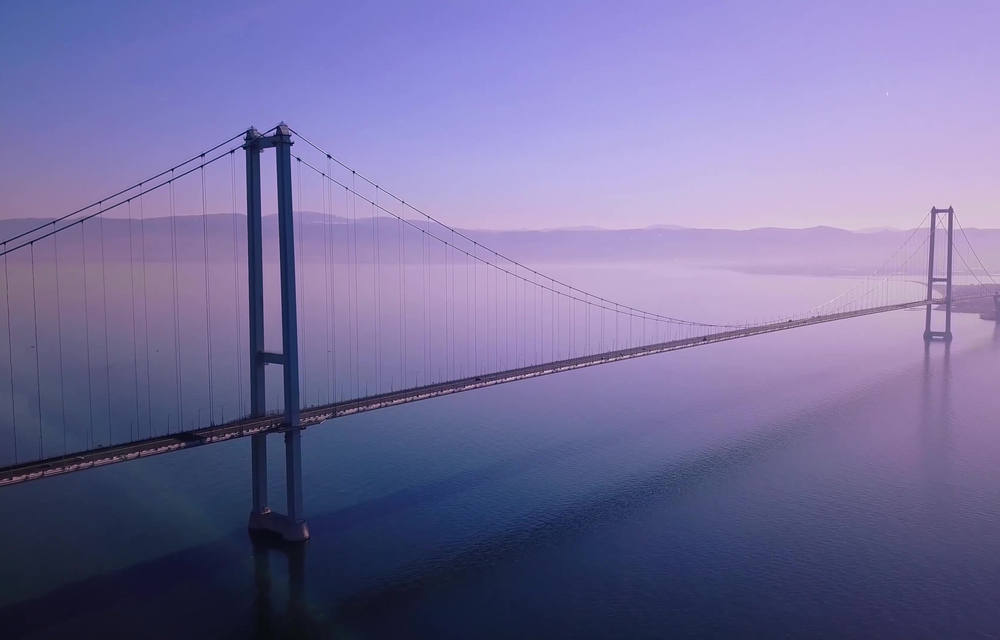
Moving a heavy steel module is not a single calculation but three interdependent problems solved at once: how the support carrying it will behave, in what sequence the lift will happen, and how much the module will deform meanwhile. Solving them separately and combining the answers does not work; change one and the other two change with it.
The support must behave like what it carries
The Osmangazi Bridge had 113 deck blocks. Each was 36 metres wide and weighed between 230 and 400 tonnes. The blocks were fabricated at ÇİMTAŞ's Gemlik facility and, before reaching site, rested on different supports at the shop, the pre-assembly area, the assembly field and the stock yard.
It is critical that the support structure behaves structurally like the module it carries. Otherwise the module can experience stresses during transport that it would never meet across its service life. A stiff support fights a flexible deck; an over-flexible one concentrates load where nobody expected it. The right answer is not halfway between the two — it lies in the behaviour of the structure being moved.
Temporary works forgive less than permanent ones
This is why temporary works are designed with the same care as the permanent structure. A bridge may last eighty years, but the support that places it works for only a few hours — and forgives nothing. In a permanent structure the margin is spread across time; in temporary works it is concentrated in a single lift.
A lift is a sequence, not a moment
The Temporary Corridor at Schiphol Airport showed this well. The 250-metre pedestrian bridge consisted of nine non-typical modules. Because of active aircraft and land traffic on the apron, only the centre module could be built in its final position; the other eight were assembled elsewhere and hauled into place with their façade glass units already mounted.
The governing constraint here was not engineering but the calendar: the main contractor held work permits for the area only at night. We carried out the structural safety evaluation of each of the eight modules through the entire process of transport and installation. All of them were placed with no damage whatsoever.
Boundary conditions change along the journey
On the MHPS gas turbine enclosures the modules were first fully stacked and assembled, then disassembled for shipment. Pipe hangers, spring cans and supports were set to their design elevation, after which separate temporary shipping supports took over for the piping systems. The same structure passed through three or four very different load cases within a few weeks.
The Cold Box renovation in Aliağa followed a similar chain: design of a new upper structure, temporary supports holding the lower structure during the works, transportation analyses for the upper structure, and a modular scheme with detailed erection analysis. Each stage began from the boundary condition the previous one left behind.
When water enters the problem
At the TÜPRAŞ İzmit Refinery the 36-inch crude oil pipes continued at sea level. That called for a bespoke pulling head shaped around the curvature of the pipes into the sea and their section — a piece that had to carry the handling loads and remain compatible with the pipe it would join.
The Cyprus Drinking Water Supply Project moved the scale somewhere else entirely: HDPE pipes 1,600 millimetres in diameter, hung from anchorage structures over spans of 500 metres, designed to sit in equilibrium 280 metres below sea level. The seabed beneath them lies at a depth of 1,500 metres.
What remains
In heavy module transport the designer's job is to build the scheme around the structure's weakest moment. That moment is usually not the day it enters service but the day it hangs from a crane half-finished, or travels down a road on a trailer. Seeing it early is what shortens the nights spent on site.
Related insights
See all
How is an existing building assessed against the current seismic code?
Performance assessment is a disciplined process running from material testing through to non-linear analysis.
How is a façade sized against wind loads?
In façade engineering, aesthetics and safety meet at the same table through wind load calculations and system detailing.
What Is Wind Load?
The pressures and suctions wind creates on building surfaces, and the difference between main structural loads and local façade pressures.