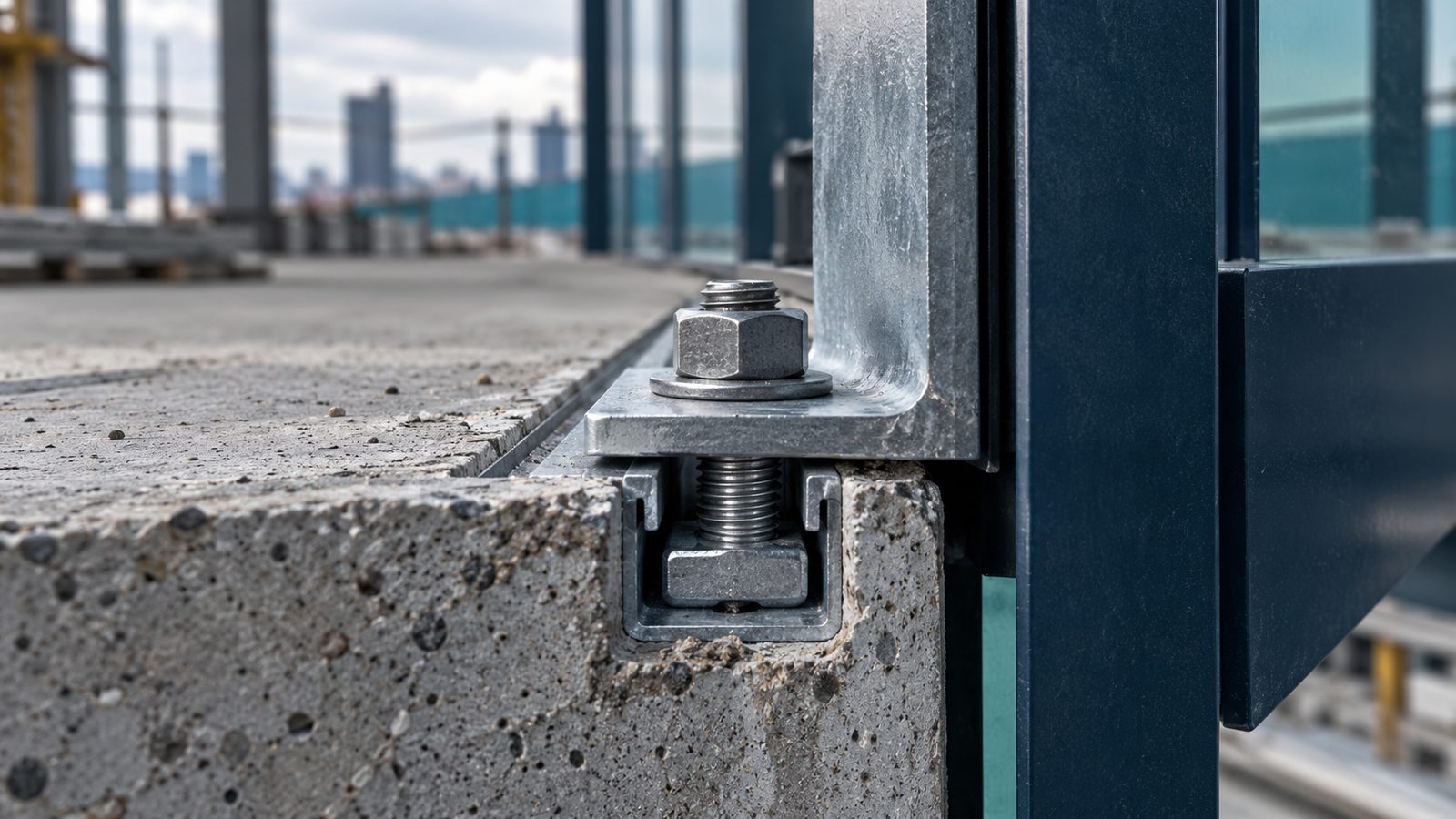
Façade anchors are the connections that transfer the loads collected in the brackets into the building's primary structure. Common options in reinforced concrete structures include post-installed expansion anchors, chemical anchors, and anchor channels cast in before the concrete is poured. Expansion anchors interact with the concrete through a friction mechanism created by tightening; they offer fast installation but require control of hole characteristics and installation torque. In chemical anchors, load transfer takes place through the bond between the anchor rod, the adhesive and the concrete, where hole cleaning, temperature and curing conditions are important. Anchor channels transfer load through anchor elements embedded in the concrete and can allow the connection position to be adjusted along the channel.
Anchor selection cannot be based on the product type alone, or on a single load capacity given in a catalogue. Concrete strength, cracked concrete conditions, edge distances, anchor spacing, embedment depth and tension-shear interaction are examined together. In seismic regions, the documented performance of the product for the relevant use and the scope of its approval are decisive. The design assesses possible failure modes such as concrete cone failure, edge breakout, pull-out and steel failure. A reliable solution combines correct product selection with calculation, installation instructions and quality control on site. Among these anchors, channel anchors are the safest for seismic regions in particular, because they transfer load through mechanical interlock and are less adversely affected by earthquake-induced cracking than the other anchor types.
Related insights
See all
What Is Structural Façade Engineering and How Does It Differ from Structural Design?
How façade elements carry load, deflect and follow building movement, and how the discipline differs from primary structural design.
How Is a Curtain Wall Calculated Structurally?
Establishing the load path, choosing fixed and sliding supports, and turning architectural intent into a buildable structural arrangement.

Curtain Wall Performance Classes to EN 13830
What EN 13830 actually classifies, how air, water and wind classes are expressed, and why a catalogue performance does not transfer automatically.